




Blog
Cold Plunge vs. DIY Ice Bath: What You Actually Get for the Money
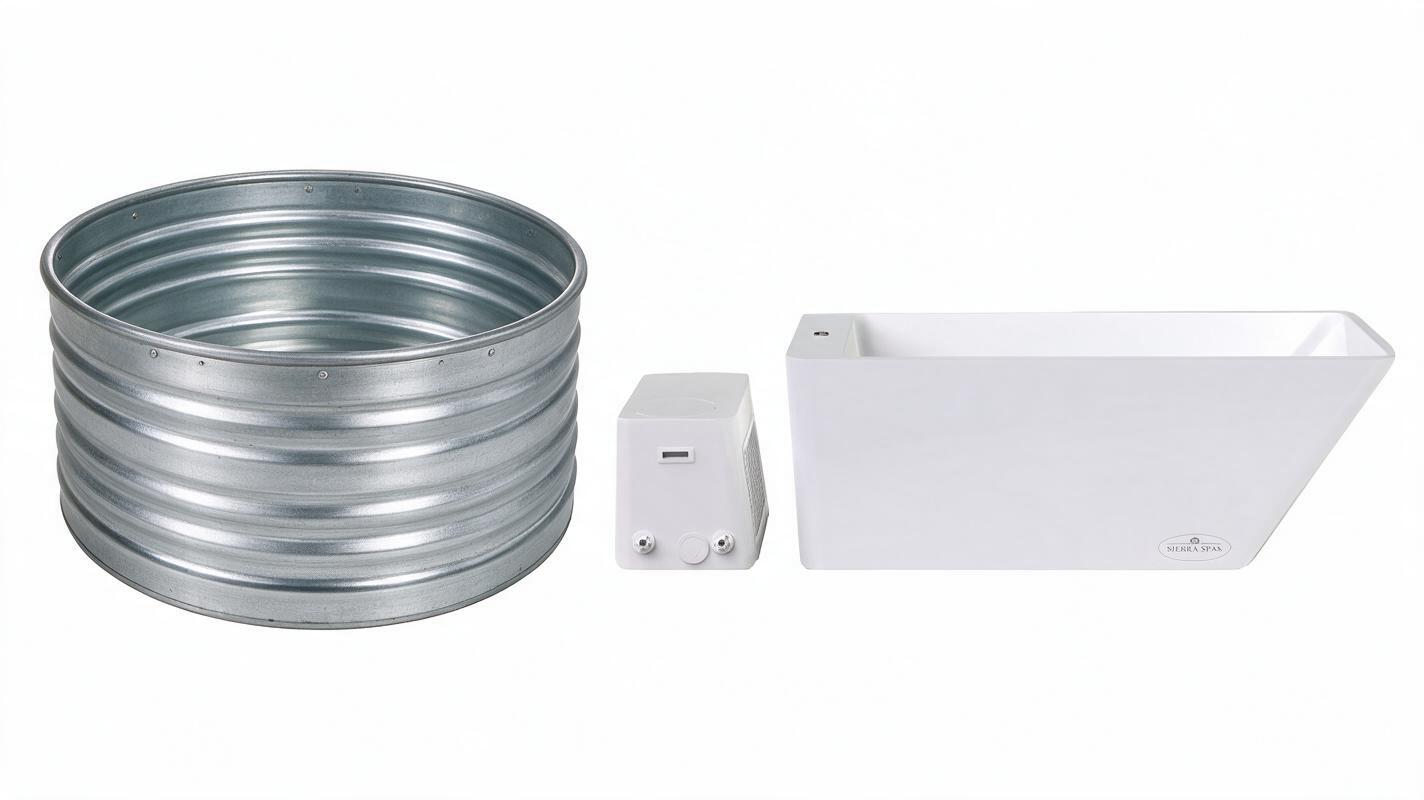
Somewhere on your feed right now, someone is climbing into a converted chest freezer in their garage, and someone else is easing into a sleek $5,000 powered plunge on a cedar deck. Both of them are getting cold. So what exactly does the extra money buy?
Fair question — and since we sell the purpose-built kind at our Richmond showroom, you might expect us to trash the DIY route. We won’t. A stock tank full of ice water works. Plenty of people should start there. But “works” and “works for you, in July, in year two” are different things, and the gap between them is exactly where your money goes.
Here’s the honest math.
The Three Ways to Get Cold
Every home cold-water setup falls into one of three buckets:
Full DIY. A stock tank, a big tote, or a converted chest freezer, cooled with bagged ice or the freezer’s own compressor. Cheapest entry, most effort.
Purpose-built passive tub. An insulated basin designed for plunging — proper depth, a drain, a cover — but no chiller. You still supply the cold. Our Plunge Basin sits in this category at \[VERIFY — recently $590].
Powered cold plunge. A tub with an integrated chiller, filter, and sanitation system that holds your target temperature around the clock. Our Plunge Pro and Plunge Pro XL are the versions on our floor at \[VERIFY — recently $4,990 and $5,990].
The buckets aren’t rungs on a moral ladder. They’re answers to different questions — how sure are you, how often will you plunge, and how much of your own labor are you willing to spend?
What DIY Actually Costs
The stock tank setup looks nearly free next to a powered plunge: a 100-gallon tank runs somewhere in the $100–$150 range, and tap water is tap water. The recurring cost is ice, and ice adds up faster than anyone expects.
Chilling a tank of Virginia tap water down to a genuine plunge temperature typically takes several bags per session — figure roughly 20–40 pounds depending on the starting temperature and how cold you want to go. At a few dollars per bag, that’s in the neighborhood of $5–$15 every time you plunge. Do the routine four days a week and the ice bill lands around $25–$60 a month — several hundred dollars a year — for a tub you also have to drain and refill every few days, because there’s no filtration keeping that water clean.
Then there’s the cost nobody puts in a spreadsheet: the ice runs. Buying it, hauling it, dumping it, waiting for the temperature to drop. That errand is the number one reason DIY plunge routines quietly die by month three. The tub still works. The owner stopped showing up.
The Chest Freezer Question
The chest freezer conversion deserves its own honest paragraph, because it’s the internet’s favorite hack and it genuinely solves the ice problem — the compressor does the chilling for you.
Here’s what you’re signing up for. A chest freezer was never designed to hold a human in water, so the build is on you: sealing the seams, adding an external thermostat controller so it doesn’t freeze solid, and rigging safe electrical. That last one is not a detail. Water, a running compressor, and a person in the tub is a combination that demands a GFCI-protected circuit at minimum, and most careful builders unplug the unit entirely before getting in. There’s no filtration, so you’re sanitizing manually and draining often. Rust arrives eventually. And the moment you modify it, the warranty is gone — you are now the manufacturer, the safety inspector, and the service department.
Thousands of people run freezer plunges without incident, and if you enjoy the project, we get the appeal. Just price in what it really is: a workaround with homework, not a product.
What a Powered Plunge Actually Buys You
When people ask why a purpose-built plunge costs what it costs, the answer isn’t the tub. It’s the four systems wrapped around it:
A chiller that solves the July problem. In a Richmond summer, an iced tub climbs out of plunge range before lunch. A chiller holds 39–55°F around the clock, in any weather, with zero ice runs — which means the plunge is ready at 6 a.m. whether or not you did anything to prepare it. That “always ready” quality is the single biggest predictor of who’s still plunging in month six.
Filtration and sanitation. A micron filter plus ozone or UV keeps the water clean and clear for two to four weeks between changes, versus every few days for an unfiltered tub. Replacement filters are cheap and stocked locally — ours run about $39. Cold plunge filters and supplies
Insulation and a fitted cover. This is why running costs stay boring. A well-insulated, covered plunge cycles its chiller intermittently, and monthly electricity typically lands closer to a refrigerator than a hot tub.
Safety and a warranty by design. Purpose-built plunges run on a standard 110V GFCI-protected outlet with sealed, tested electrical — engineered for a wet human, not adapted for one. And when something needs service, you call us instead of a forum.
For the full spec-by-spec breakdown, our cold plunge buyer’s guide goes deeper on each system.
Side by Side: Where the Money Goes
| Stock tank + ice | Chest freezer build | Purpose-built basin | Powered plunge | |
|---|---|---|---|---|
| Upfront cost | \~$100–$150 | ~$200–$450 with parts | [VERIFY — recently $590] | [VERIFY — recently $4,990–$5,990] |
| Ongoing cost | Ice: roughly $25–$60/mo at 4x/week | Modest electricity | Ice, as used | Modest electricity |
| Effort per session | Buy, haul, and dump ice; wait for temp | Ready when maintained | Add ice or cold water | None — set it and plunge |
| Water changes | Every few days | Every few days | Every few days | Every 2–4 weeks |
| Works in a VA summer | Barely | Yes | With lots of ice | Yes |
| Electrical safety | N/A | Your responsibility | N/A | Engineered, 110V GFCI |
| Warranty \& service | None | None (voided) | Manufacturer warranty | Full warranty + local service |
The Honest Break-Even
Let’s not pretend the math says something it doesn’t. If you compare a powered plunge to a stock tank purely on ice savings — several hundred dollars a year — the payback period stretches most of a decade. Nobody should buy a $5,000 plunge to save money on ice, and we’d rather tell you that than have you do the arithmetic in the parking lot.
What the money actually buys is consistency. Cold plunging pays off through repetition — a few minutes, most days, for months — and every ounce of friction between you and the water erodes that. The DIY tub costs less and demands more; the powered plunge costs more and demands nothing. Which one you’ll still be climbing into next winter is the real comparison, and only you know your own follow-through.
There’s a middle path, too, and it’s underrated: a purpose-built passive basin gives you proper depth, real insulation, a drain, and a cover for a few hundred dollars. It’s the honest test drive — if you’re still hauling ice happily after three months, you’ve earned the chiller.
Our Recommendation, by Situation
“I’m curious but not sure I’ll stick with it.” Start cheap — a stock tank or the Plunge Basin. Prove the habit before you fund it. Pair it with the contrast therapy starter plan and give it a real month.
“I’m already plunging and tired of the ice runs.” You’re the powered-plunge customer. The Plunge Pro removes every excuse between you and the water.
“I’m over six feet tall.”
Go XL. Depth and length are the specs that make or break daily use — come sit in one before you decide.
“I want the freezer project.”
Genuinely fine — just wire it safely, sanitize on schedule, and know you’re on your own for service.
Come Do the Comparison in Person
Photos flatten the differences. Standing next to a basin and a powered plunge — feeling the insulation, checking the depth, seeing what a chiller unit actually looks like — settles the question in about five minutes.
Both are on our floor at 2501 Glen Center Street in Richmond, prices marked, no pressure. We’ve been outfitting Virginia backyards since 1977, and we’d rather match you to the right tub than the expensive one.
Visit Monday–Friday, 8 a.m.–5 p.m. (Saturdays by appointment), or call 804-203-0207. Get directions to our showroom
FAQ
How much ice does a DIY ice bath use?
Chilling a roughly 100-gallon tub to plunge temperature typically takes about 20–40 pounds of bagged ice per session, depending on starting water temperature and your target. At a few dollars per bag, regular use commonly runs $25–$60 per month in ice.
Is a chest freezer cold plunge safe?
It can be run safely, but the safety work is entirely on the owner: a GFCI-protected circuit is essential, many users unplug the unit before entering, and the tub requires manual sanitizing and frequent draining since there’s no filtration. Modifying the freezer also voids its warranty.
Do powered cold plunges cost a lot to run?
No. A well-insulated powered plunge with a cover cycles its chiller intermittently, so monthly electricity is typically modest — closer to running a refrigerator than a hot tub.
Is a stock tank ice bath worth it?
As a starting point, yes. It’s the cheapest way to test whether cold plunging fits your routine. Its weaknesses are ongoing ice costs, frequent water changes, and poor summer performance — which is why committed users tend to upgrade to a powered plunge.
Can a DIY ice bath stay cold in summer?
Not for long. Summer heat pulls an iced, unpowered tub above useful plunge temperatures within hours, so hot-weather plunging on a DIY setup means heavy ice use or very early sessions. A chiller is what makes July plunging practical in Virginia.