




Blog
Infrared vs. Traditional Sauna: Cost, Heat-Up Time, and Which Fits Your Home
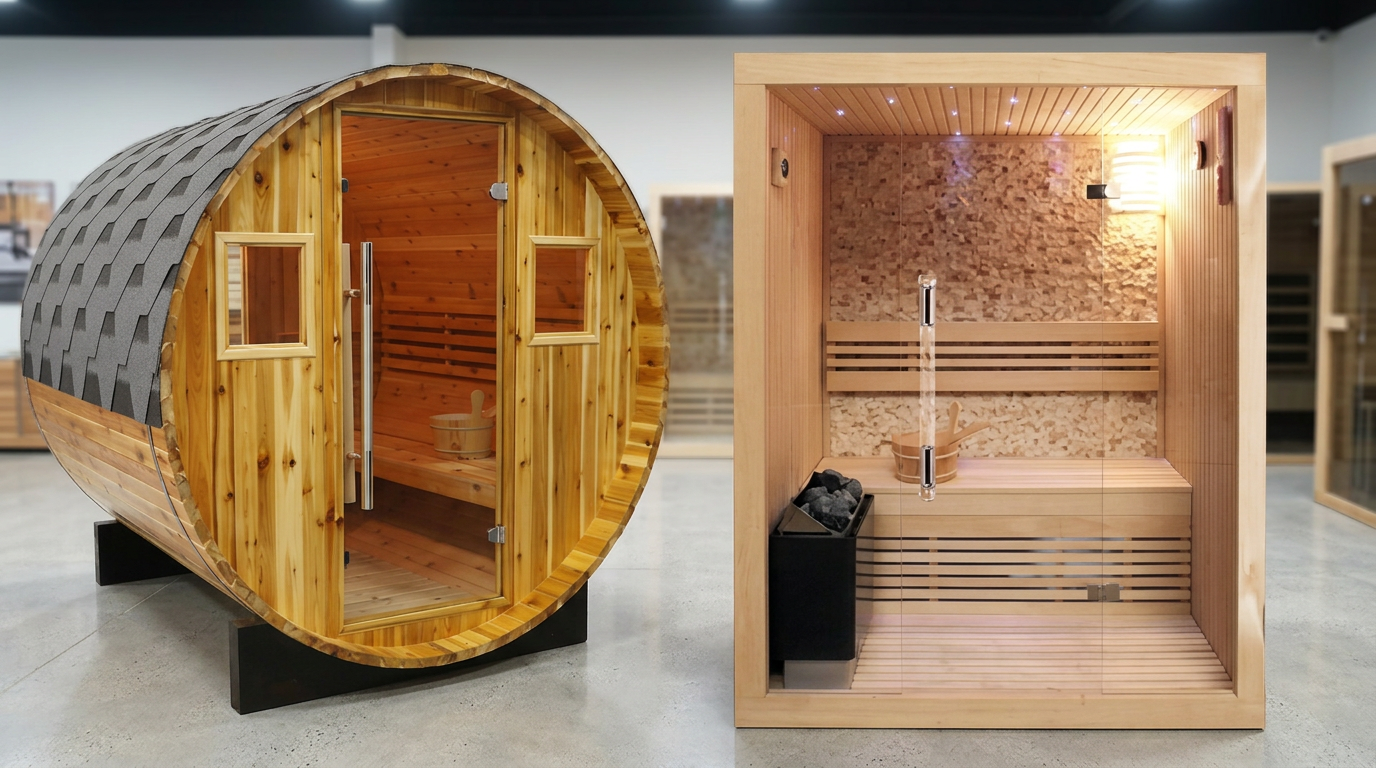
Stand in our Richmond showroom long enough and you’ll hear the same conversation on repeat: a couple standing between an infrared cabin and a cedar barrel sauna, asking which one is “better.”
Wrong question — and we say that as a shop that sells both. Infrared and traditional saunas produce genuinely different experiences, fit different homes, and cost different amounts to install and run. One of them is right for you; it’s just not the same one for everybody. Here’s the comparison we walk through on the floor, with our actual prices attached.
The Core Difference in One Paragraph
A traditional sauna heats the room — an electric heater (ours use Finnish-made Harvia units) warms the air to 150–195°F, you ladle water over the rocks for a burst of steam, and the hot air does the work. An infrared sauna heats you — panels emit infrared warmth your body absorbs directly, so the air stays a gentler 120–140°F while you still break a full sweat. Same destination, two different roads: one intense and ritualistic, one mild and low-friction.
Heat-Up Time: The Difference You’ll Feel Daily
This is the practical gap nobody mentions until they own one.
A traditional sauna needs its room and rocks up to temperature before the session starts — figure 30–45 minutes of preheat, a bit longer for an outdoor barrel on a cold Virginia morning. Owners build a rhythm around it: flip the heater on, go about your evening, return when it’s ready. It becomes part of the ritual, but it is a ritual.
An infrared sauna is ready in 10–15 minutes, and because the panels warm your body directly, you can step in while it’s still climbing. That makes infrared the low-friction option — the lunch-break session, the spontaneous 9 p.m. unwind. If your honest self knows that a 40-minute lead time means you’ll skip sessions, this single spec might make your decision.
Cost to Buy: Closer Than You’d Think
Here’s where our floor sits right now:
| Type | From our floor | Price |
|---|---|---|
| Infrared | 3-Person Outdoor Infrared Sauna | [VERIFY — recently $3,790] |
| Traditional (indoor) | 4-Person Indoor Sauna with 6kW Harvia heater | [VERIFY — recently $3,896] |
| Traditional (outdoor barrel) | Aurora 2–4 Person Barrel / Oasis Canopy Barrel | [VERIFY — recently $4,990 / $5,490] |
| Luxury indoor cabins | Rockledge 2-Person / Westlake 3-Person | [VERIFY pricing — recently $4,790 / $4,990 — and CONFIRM whether these are infrared or traditional so they land in the right row] |
Notice what the table says: at our showroom, purchase price barely separates the two types — comparable sizes land within a few hundred dollars of each other. The real cost differences show up after the sale.
Cost to Install: Where Traditional Gets Pricier
Infrared keeps installation simple. Most residential units assemble in an afternoon and many plug into a standard 110V outlet — larger models may want a dedicated circuit, but the electrical story is generally painless.
Traditional means a real heater — a 6kW Harvia draws serious power and requires a dedicated 220V circuit installed by a licensed electrician. It’s the same dedicated-circuit math as a hot tub: commonly $800–$2,500 depending on your panel’s distance and capacity, as we covered in our hot tub cost guide. If you already have spa wiring or panel headroom, this shrinks; if your panel is full, get the electrician’s quote before you commit.
Cost to Run: Both Cheap, One Cheaper
Neither sauna will move your electric bill much — sessions are short. At Dominion’s roughly 15¢/kWh effective rate hot tub running-cost math:
Infrared: panels draw modest power for a 30–40 minute session — call it 15–30¢ per session, a few dollars a month at four sessions a week.
Traditional: a 6kW heater running through preheat plus your session uses several kilowatt-hours — roughly 60¢–$1.20 per session, or $10–$20 a month at heavy use.
Traditional costs three to four times more per session and still less than a streaming subscription per month. Running cost shouldn’t decide this for you — but it’s honest to note the preheat is where a traditional sauna’s electricity goes.
Which Fits Your Home?
Infrared fits inside your house. A spare bedroom corner, a finished basement, a garage bay — infrared cabins need a solid level floor, an outlet, and modest clearance. No steam means no moisture management. If square footage is the constraint, our guide to saunas for small spaces covers the compact options.
Traditional fits your backyard — or a dedicated indoor spot. The barrel saunas are outdoor pieces by design, and they’re gorgeous ones; an indoor traditional room wants proper heater clearances and a spot that can shrug off heat and occasional steam. If you’re picturing the full Finnish scene — cedar, rocks, a hiss of steam, snow on the roof someday — this is that.
Doing contrast therapy? Both pair beautifully with a cold plunge; traditional delivers the bigger hot-to-cold swing, infrared makes the heat phase gentler and longer. Our contrast therapy routine guide covers how each type slots into the rounds.
The Health Question, Answered Honestly
Here’s the part most sauna marketing fudges, so we won’t.
The deepest research on sauna benefits — including the long-running Finnish studies associating regular use with cardiovascular health — was conducted on traditional saunas, because that’s what Finland has been using for generations. Infrared’s gentler heat very likely shares much of the same mechanism (heat is heat, and the sweat is real), and many users find its milder sessions easier to sustain — but some infrared-specific claims floating around, particularly about detoxification, run well ahead of the evidence. Our article on infrared sauna health benefits walks the supported ground.
The honest summary: both deliver the core experience — deep relaxation, a genuine sweat, and the heat exposure that research keeps finding good things about. Choose based on which sessions you’ll actually repeat, not on marketing claims. And as with everything in this category: if you have a cardiovascular condition or are pregnant, talk with your doctor before making heat a habit.
The Decision, Simplified
Choose infrared if: you find intense heat uncomfortable, you want zero-friction sessions on a whim, your sauna is going inside the house, or you’d rather skip the electrician.
Choose traditional if: you want the classic Finnish experience with steam, you love the look of a backyard barrel, you’re building a contrast therapy setup with maximum hot-cold swing, or the preheat ritual sounds like a feature rather than a chore.
Still torn? This is exactly what showrooms are for. We keep infrared cabins, Harvia-heated rooms, and barrel saunas side by side at 2501 Glen Center Street in Richmond — sit in both, feel the difference between air heat and panel heat, and the decision usually makes itself in ten minutes.
Visit Monday–Friday, 8 a.m.–5 p.m. (Saturdays by appointment), or call 804-203-0207. Get directions
FAQ
Which is better, an infrared or traditional sauna?
Neither is universally better. Traditional saunas deliver the classic high-heat, steam-capable Finnish experience and back the deepest body of research; infrared saunas run gentler, heat up faster, and install more easily indoors. The better sauna is the one whose sessions you’ll actually repeat several times a week.
Do infrared saunas get hot enough?
Yes, for their design. Infrared cabins hold a 120–140°F ambient temperature but warm your body directly through infrared panels, producing a full sweat at air temperatures that feel far milder than a 180°F traditional room. It’s a different heat experience, not a weaker one.
Which sauna costs more to run?
Traditional — roughly three to four times more per session, mainly due to the 30–45 minute preheat. In practice both are cheap: at Virginia electric rates, infrared runs a few dollars a month and traditional roughly $10–$20 at frequent use.
How long does a traditional sauna take to heat up?
Typically 30–45 minutes for the room and rocks to reach temperature, longer for outdoor units in cold weather. Infrared saunas are ready in 10–15 minutes, and you can enter while they finish warming.
Can you put an infrared sauna inside your house?
Yes — indoors is the most common placement. Infrared cabins need a solid level floor, an appropriate outlet, and modest clearance, with no steam or moisture management required, which makes spare rooms, basements, and garages popular spots.